
Beyond GDP and Toward an Economy Answerable to Life
This Project Hub gathers the materials for An Economy Answerable to Life: Beyond GDP, Unequal Exchange, and the Life-Coherent Reordering of Progress.
This work applies the Life-Coherent Framework to economy, progress, money-value, life-value, civil commons, debt, unequal exchange, provisioning, and the conditions through which societies protect or degrade life-capacity.
The guiding question is:
What must be protected, restored, or redesigned so that economy becomes answerable to life?
Why This Project Matters
Economy is not an end in itself.
At its root, economy means the ordering of the household. At civilizational scale, this means the ordering of our shared household: food, water, shelter, care, energy, health, education, land, work, culture, ecology, and the conditions through which life can continue.
Modern economies often measure success through GDP, growth, consumption, investment, competitiveness, productivity, profit, and financial return.
These measures can be useful, but they are not enough.
An economy can grow while life-capacity contracts.
GDP can rise with sickness, disasters, pollution cleanup, military expenditure, overwork, debt expansion, ecological destruction, and privatized repair of harms that should not have occurred.
The deeper question is not simply:
Did the economy grow?
The deeper question is:
What happened to life as it grew?
The Core Claim
An economy becomes legitimate only insofar as it serves life.
This means it must:
protect life-capacity
secure the life-ground
strengthen civil commons
repair life-damage
reduce preventable suffering
support care and contribution
remain democratically answerable
preserve future possibilities
respect ecological limits
serve communities and ecosystems rather than abstract accumulation
The task is not only to move beyond GDP.
The task is to bring forth an economy answerable to life.
The Great Economic Inversion
Money was created to serve life.
But life is increasingly reorganized to serve money.
Food becomes commodity before nourishment.
Housing becomes asset before shelter.
Health becomes market before care.
Education becomes credential before life-capacity development.
Land becomes real estate before life-ground.
Work becomes labor-cost before contribution.
Nature becomes resource before living condition.
Time becomes productivity before lived life.
This is the great economic inversion.
A life-coherent economy asks:
Is money serving life, or is life serving money?
Money-Value and Life-Value
Money-value asks:
What can be priced, owned, exchanged, accumulated, or controlled?
Life-value asks:
What enables life to live, develop, heal, relate, participate, create, and flourish?
Something can increase money-value while reducing life-value.
A forest can be more valuable as timber than as watershed, habitat, climate stabilizer, cultural place, and living ecology.
A war can grow GDP while destroying communities.
A financial product can generate wealth while increasing debt, insecurity, and dependency.
A country can appear economically successful while its people become sicker, more anxious, more indebted, more lonely, and less free.
The life-coherent question is:
What happens to life-capacity when money-value expands?
Beyond GDP
GDP measures monetary activity.
It does not tell us whether life is becoming more livable.
A life-coherent measure of progress must ask:
Are basic life-necessities secure?
Are people healthier?
Are children developing well?
Are communities more trusting?
Are ecosystems regenerating?
Are people less burdened by debt and insecurity?
Are civil commons stronger?
Are people more able to participate meaningfully?
Are future generations inheriting greater or lesser life-capacity?
Beyond GDP does not mean beyond measurement.
It means measurement made answerable to life.
Unequal Exchange and Life-Drain
At global scale, economic systems can move value from some regions to others while concealing the transfer.
This can occur through trade rules, debt obligations, intellectual property regimes, resource extraction, labor arbitrage, tax avoidance, climate vulnerability, and unequal bargaining power.
For small island developing states and formerly colonized regions, progress cannot be separated from historical and ongoing life-drain.
A life-coherent economy asks:
What flows out?
What flows in?
Who controls the terms?
What capacities are being built?
What capacities are being depleted?
What debts are financial?
What debts are ecological, historical, cultural, and moral?
Progress cannot be honest unless it accounts for life-drain.
Civil Commons as Economic Foundation
The civil commons are not outside the economy.
They are the life-enabling foundation without which no economy can function.
Clean water, public health, education, care systems, ecological protections, food security, public infrastructure, emergency response, democratic accountability, cultural memory, and shared knowledge are forms of life-capital.
They are not merely expenses.
They are the shared conditions of economic possibility.
A life-coherent economy asks:
Are we strengthening the shared conditions of life, or liquidating them for short-term gain?
Project Materials
The full materials remain in the original project post; this Hub provides a guided entrance into them.
Read
Original Project Post
The full archival post containing the project materials.
Academic White Paper / Full Document
The full scholarly version of the economy and progress framework.
Executive Summary
A shorter entrance into the central argument.
Listen
Deep Diver | An economy answerable to life
A conversational entry into the project’s core themes.
Debate | Making the Global Economy Answerable to Life
A critical exchange testing the argument.
Critique | Life Coherent Economics for Small Island States
A reflective stress-test of the framework.
Watch / See
Video Explainer | An Economy Answerable to Life
A shorter public-facing explanation of the project, where available.
Cinematic Explainer | The Measurement Paradox: Why “Beyond GDP” is Failing
A narrative version for wider audiences, where available.
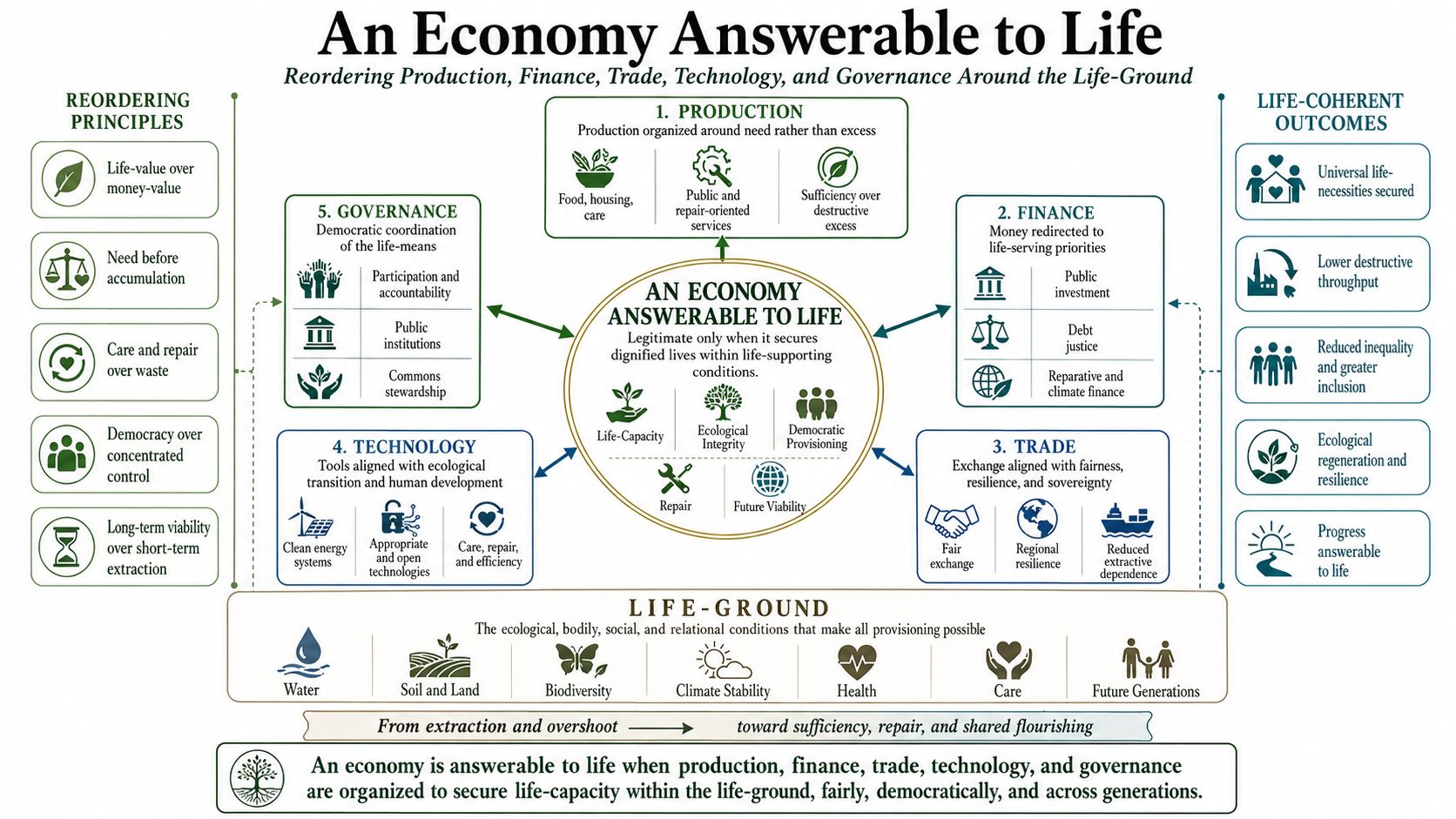
Master Diagram / Infographic
A visual map of life-coherent progress, beyond-GDP indicators, civil commons, and an economy answerable to life.

How This Project Connects to the Commons
This project connects directly to the main pathways of the Life-Knowledge Commons:
The Life-Coherent Framework — the core grammar.
Economy & Progress — the main pathway for this project.
Tools for Life-Coherent Repair — practical questions, dashboards, and worksheets.
Caribbean / SIDS Lab — place-based application under real constraints of debt, climate, food, water, tourism, and sovereignty.
Health & Healing — the health consequences of economic arrangements.
Peace & Repair — the relation between economy, deprivation, structural violence, and peace.
Library — the deeper archive of related materials.
Suggested Pathway
For a gentle entry, proceed in this order:
- Read this Project Hub.
- Visit the original project post.
- Read the Executive Summary.
- Listen to the Deep Dive or Debate.
- Open the full Academic White Paper when ready.
- Return to Tools for Life-Coherent Repair and ask how economic systems can be evaluated by life-capacity.
No one needs to enter the whole project at once.
Begin where the concern is alive.
Working Questions
Use this project to ask:
What is being counted?
What is being ignored?
What is being accumulated?
What is being depleted?
Who gains security?
Who absorbs insecurity?
What life-capacities are expanding?
What life-capacities are contracting?
What civil commons are being strengthened or weakened?
What claims does money have over life?
What would an economy answerable to life require?
Invitation
Economy becomes life-coherent when it remembers its place.
It is not the master of life.
It is a means through which life is provisioned, protected, repaired, and developed.
The central question is therefore not:
How do we make the economy grow?
The deeper question is:
How do we organize our shared household so that life can remain livable, dignified, participatory, and flourishing across generations?