

Audiobook on ElevenReader (Listen)
Download Full Document (PDF)
Architectures of Recursive Viability (PPT) (PDF)
The Living Blueprint (PPT) (PDF)
Deep Dive | The Seven Part Grammar of Survival
Debate | Exceptional Mathematics and the Architecture of Viability
Critique | Grounding the Mathematical Architecture of Viability
Video Explainer | The Dynamic Architecture
Cinematic Explainer | The Geometry of Collapse: A 7-Function Grammar of Viability
Please click on infographic to enlarge
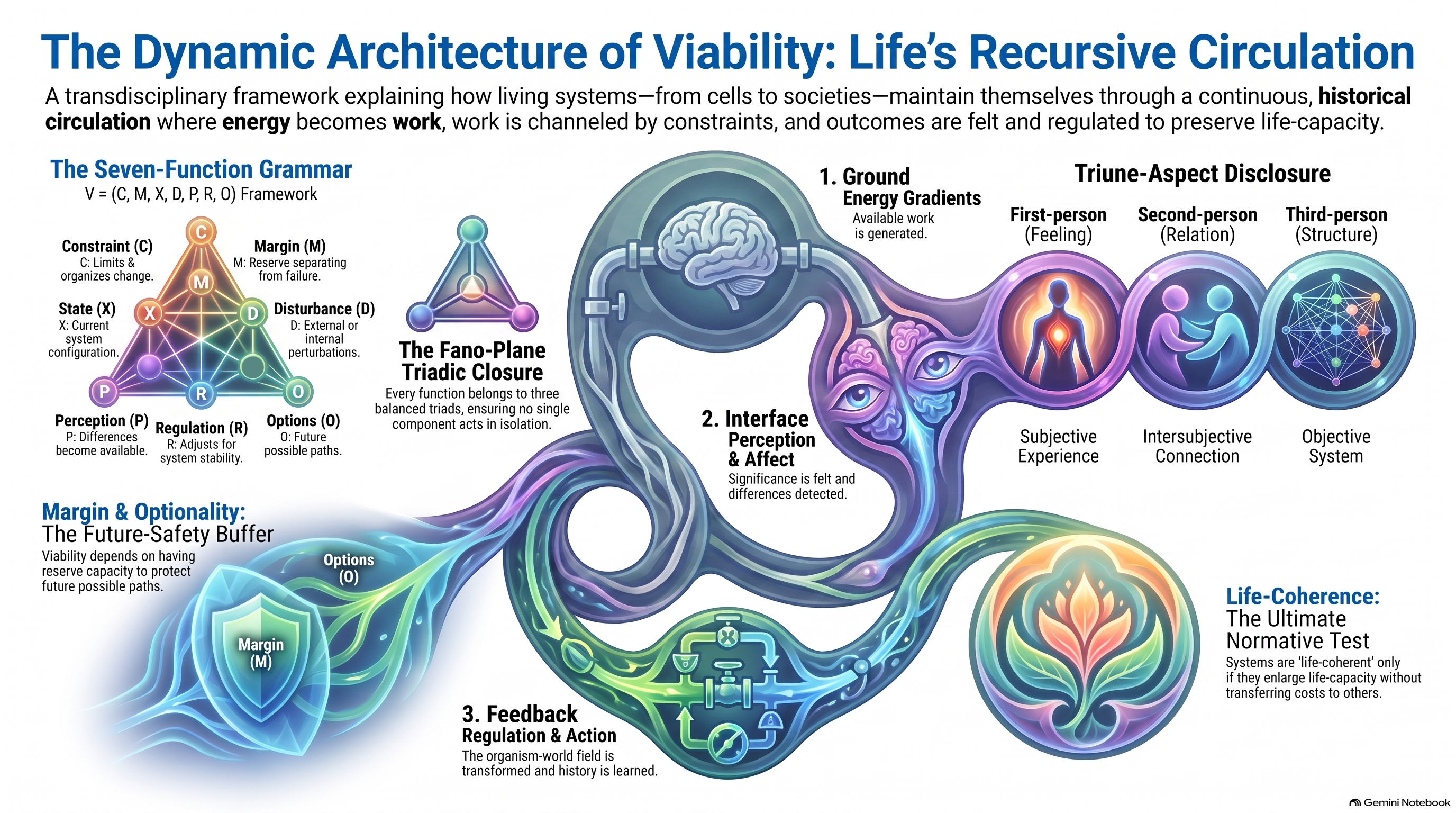
Please click on Master Diagram to enlarge

Executive synthesis
The papers gathered behind this monograph already contained most of the required parts. What they lacked was not another concept but a stable account of how the concepts move together. The primary distinction explained how a domain can begin. Autopoiesis explained how a living unity constitutes and conserves itself. Teleodynamics explained how constraints can be organized around absent ends. Active inference explained anticipatory regulation under uncertainty. Emotional sentience and affective neuroscience explained why viability must be weighted rather than merely represented. The I–You–It windows explained why reality is never exhausted by detached observation. The viability grammar specified recurring functional relations. The exceptional programme asked whether those relations possess deeper formal closure. Life-value and the biology of love supplied an answer to the question that pure systems theory cannot settle: coherence for whom, at whose cost and in service of what manner of living?
The integration can be stated in one sentence:
Energy becomes living work when recursively regenerated constraints preserve a bounded organization; that organization senses and feels the significance of its changing relation to the world, acts through historically learned options, and — in human coexistence — can reflectively conserve relations that enlarge rather than disable life.
This sentence contains five transitions that must not be collapsed.
- Energy to organization. Energy is necessary for every material transformation, but energy alone does not specify form, function, beneficiary or value. Constraint selects pathways and prevents most physically possible changes from occurring.
- Organization to immanent norm. In a self-producing system, some outcomes preserve the organization and others destroy it. This establishes an organism-relative good/bad polarity without yet proving phenomenal feeling.
- Immanent norm to felt valence. In animals, distributed homeostatic, interoceptive, brainstem, hypothalamic, limbic and cortical processes integrate bodily significance into felt states. The proposal that feeling is the intrinsic aspect of this integrated regulation is a metaphysical identity hypothesis supported by structural fit, not deduced from nonexperiential premises.
- Feeling to relation and world. A subject does not merely register an environment. Through action and structural coupling it enacts a lived world. With other subjects, mutual responsiveness creates a second-person domain that cannot be reconstructed from two isolated first-person reports plus an external description.
- System coherence to life-coherence. A tumour, bureaucracy, market, military apparatus or propaganda network can be internally coherent while destroying its host conditions. Persistence, efficiency and integration are therefore insufficient norms. Life-capacity across affected scales supplies the evaluative test.
The proposed ontology is triune-aspect process monism: one reality of relational becoming, disclosed intrinsically as felt presence, participatorily as mutual address and extrinsically as organization. “Aspect” does not mean three detachable substances. “Window” does not imply that the three accounts are optional perspectives on an otherwise featureless object. Each discloses relations that the others cannot replace. The first-person window supplies lived significance; the second-person window supplies recognition, trust, obligation and co-regulation; the third-person window supplies public measurement, causal modelling and reproducibility.
The proposed functional grammar is V = (C, M, X, D, P, R, O). These terms are roles in a recurrent cycle, not chronological stages and not seven substances. Constraint shapes the viable region; margin indicates reserve before a critical boundary; state names the present configuration and trajectory; disturbance perturbs it; perception detects relevant difference; regulation changes action or internal organization; options are the viable paths still available. Because each function receives meaning through the others, additive scorekeeping is inadequate. Relational coherence is the object of study.
The proposed formal programme proceeds through four levels:
- Grammar: which distinctions and triads must be represented?
- Algebra: how do the operations compose, and how does order matter?
- Geometry: what is the shape of the viable region, its boundaries, distances, directions and curvature?
- Dynamics: how do energy, disturbance, inference, regulation, learning and history move the system through that geometry?
The proposed research discipline uses five claim classes throughout this monograph.
| Status | Meaning | Typical examples here |
| Established result | Empirically well supported or mathematically proved within its domain | thermodynamic conservation; neural dependence of wakeful affect; Fano incidence; octonionic nonassociativity; Spin(8) triality |
| Scientific framework | A serious, productive but revisable explanatory programme | autopoiesis; teleodynamics; free-energy principle; active inference; affective neuroscience |
| Bridge hypothesis | A proposed mapping that can guide formalization and tests | seven functions as a minimal grammar; global viability compression as a correlate of affect; exceptional structures as models of relational closure |
| Metaphysical hypothesis | A claim about what reality or experience ultimately is | triune-aspect process monism; analytic idealism; panexperientialism; phenomenal identity of integrated valence |
| Normative or theological judgment | A claim about what ought to be conserved or how life should be lived | life-coherence; legitimate otherhood; the Greatest Commandment as a grammar of relation |
The synthesis therefore closes a conceptual circuit without pretending to close every explanatory gap. Its strongest conclusion is methodological: no adequate science of viability can be purely energetic, computational, phenomenological, interpersonal, mathematical or ethical. It must coordinate these domains while preserving their differences.
Recurrent Viability Functions and Their Definitions
Please scroll to the right to see the right columns| Function Name | Symbol | Operational Definition | System Role | Failure Mode |
|---|---|---|---|---|
| Constraint | C | What limits and organizes possible change, including physical boundaries, rules, and habits. | Shapes the viable region and selects pathways by restricting degrees of freedom. | Pathological persistence after enabling function is lost; enabling through exclusion fails. |
| Margin | M | Reserve or distance separating the present state from a critical viability boundary. | Provides room for correction, learning, and protected variation. | Hidden depletion; apparently normal state near a cliff; normalization of deviance. |
| State | X | The present configuration and trajectory, including rates of change and hidden burden. | Names the current position within the viability geometry. | Inaccurate trajectory assessment; hidden load not accounted for in snapshot. |
| Disturbance | D | Perturbations (external or endogenous) acting on the process relative to its vulnerability. | Acts as a forcing field that triggers system responses. | Overwhelming intensity, timing, or coupling relative to current reserve. |
| Perception | P | How relevant differences (viability-relevant information) become available to regulation. | Detects consequential differences across biological, organismic, or social scales. | Blindness, noise, delay, suppression, metric capture, or proxy substitution. |
| Regulation | R | Action or internal change that maintains, restores, or transforms viable organization. | Changes action or internal organization based on sensed significance. | Overreaction, underreaction, delay, mistargeted response, or rigid control. |
| Options | O | The set of viable paths still available and enactable without transferring intolerable cost. | Links freedom to embodiment, resources, and relationship; represents future viability. | Tunnel vision, learned helplessness, counterfeit options, or catastrophic narrowing. |
2 thoughts on “THE DYNAMIC ARCHITECTURE OF VIABILITY: From Distinction, Energy, Constraint, and Absence to Sentience, Relation, and Life-Coherent Worlds”