

[Download Full Document (PDF)]
Deep Dive | Why trying harder destroys complex systems
Debate | Why Stabilizing Numbers Destroys Complex Systems
Critique | Mapping E7 to Operational Proxies
Explainer | Operationalizing Viability
Cinematic | Operationalizing Viability: The Load Trap
Click on infographic to enlarge
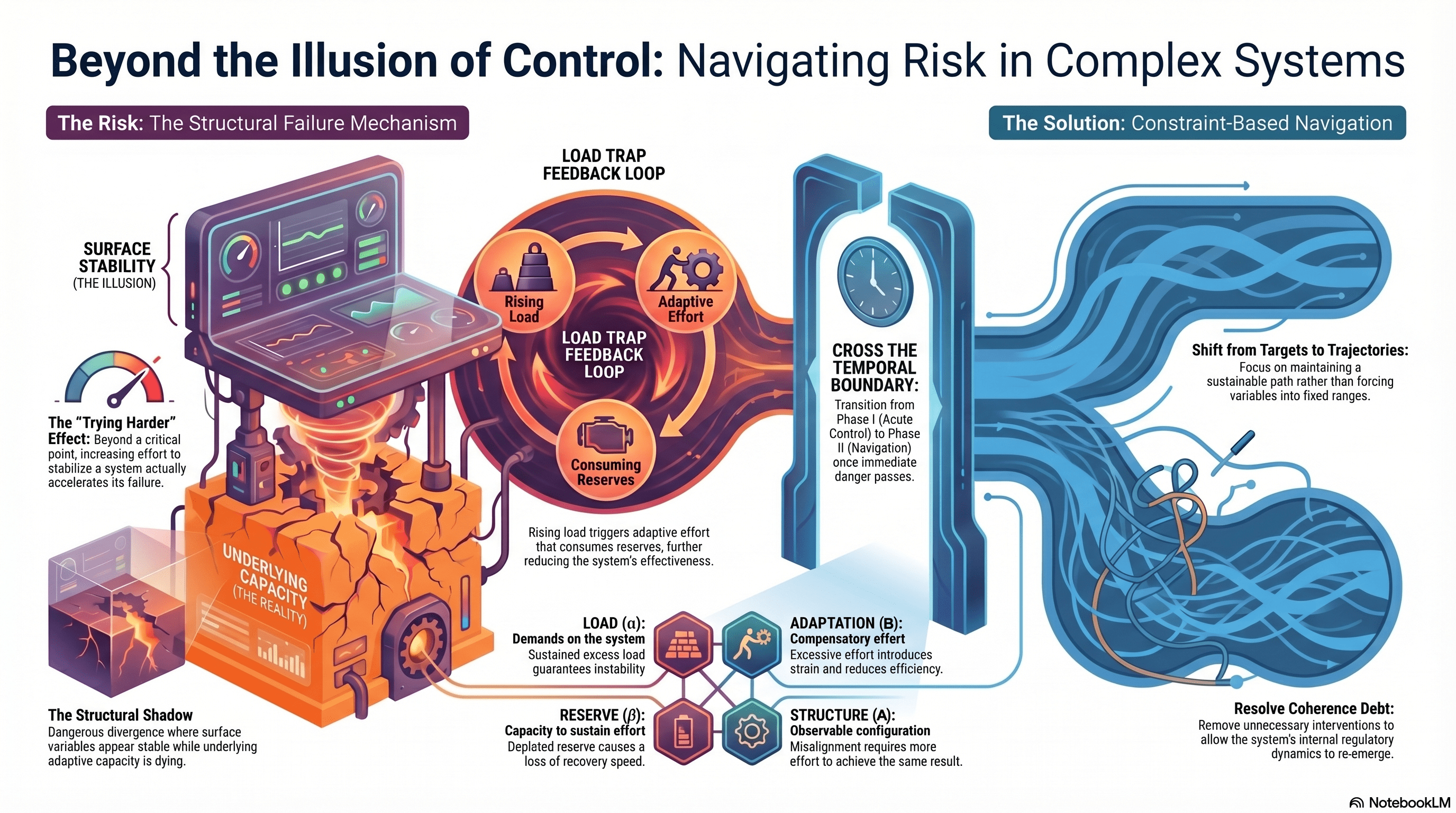
EXECUTIVE SUMMARY
Complex systems are often managed by controlling observable variables. This approach assumes that maintaining outputs within defined ranges ensures stability. In complex adaptive systems, this assumption does not hold. Observable variables reflect underlying relationships rather than determine system behavior, and interventions that stabilize outputs can degrade the conditions required for persistence.
This paper introduces a constraint-based framework for understanding and managing such systems. Viability is defined as the ability of a system to sustain coherent trajectories over time. It depends on maintaining balance among four interacting components: load, adaptation, reserve, and structure. When this balance is disrupted, systems enter a load trap in which increasing effort depletes capacity and accelerates collapse.
To guide intervention, a dual-scale paradigm is developed. In conditions of acute instability, direct control is necessary to restore minimal function. However, once the system stabilizes, continued control increases strain. At this point, intervention must shift to constraint-based navigation, which focuses on reducing load, restoring reserve, limiting excessive effort, and correcting structural misalignment.
The Viability Navigation Protocol provides a structured method for applying this approach. It links relational assessment of system state to iterative intervention guided by system response. Rather than optimizing variables, it maintains trajectories within viable bounds.
The framework is demonstrated in a clinical case and generalized across engineered, economic, and governance systems. In each domain, similar patterns of failure emerge when effort substitutes for capacity over time.
The central conclusion is that stability cannot be achieved through the control of variables alone. It requires maintaining the conditions that allow systems to adapt without exhausting their capacity.
Summary of Viability Components and Failure Patterns Across Domains
Please scroll to the right to see the right columns| Domain | Load Proxies | Adaptation Proxies | Reserve Proxies | Structure Proxies | Failure Pattern | Intervention Principle |
|---|---|---|---|---|---|---|
| Medicine (Clinical Systems) | Physiological demand, stressors, fluid imbalance | Pharmacologic support, compensation effort, heart rate | Tissue perfusion, metabolic recovery, buffering capacity | Blood pressure, macroscopic variables, observable state | Load trap (escalating support maintaining BP while impairing tissue perfusion), structural shadow | Reduce demand, restore perfusion/flow rather than just pressure, reduce unnecessary intervention |
| Engineered Systems (Wastewater) | Inflow variation, contaminant levels | Aeration, chemical dosing, process control adjustments | Health/diversity of biological system, buffering capacity | Effluent quality, process output | Structural shadow (acceptable output masking biological stress), load trap | Reduce load, restore biological capacity, reduce unnecessary intervention |
| Economic Systems | Debt, inflationary pressure, external shocks | Policy intervention, fiscal and monetary measures | Savings, institutional capacity, trust | Production, employment, output measures | Structural shadow (stabilized indicators masking systemic fragility), load trap | Reduce systemic load, rebuild reserve, limit excessive intervention |
| Governance Systems | Social pressure, inequality, external stress | Enforcement, regulation, centralized control | Social cohesion, legitimacy, trust | Institutional order, compliance | Structural shadow (surface order masking erosion of trust), load trap | Reduce sources of stress, restore trust, realign institutions |