

Audiobook on ElevenReader (Listen)
Download Full Document (PDF)
The Living Blueprint (PPT) (PDF)
Restoring Life Coherent Institutions (PPT) (PDF)
Deep Dive | Why institutions prioritize metrics over people
Debate | Why institutions put survival before people
Critique | Breaking the cycle of institutional self-preservation
Video Explainer | Loss of the Social
Cinematic Explainer | Diagnosing the Civilizational Paradox
Click on infographic to enlarge
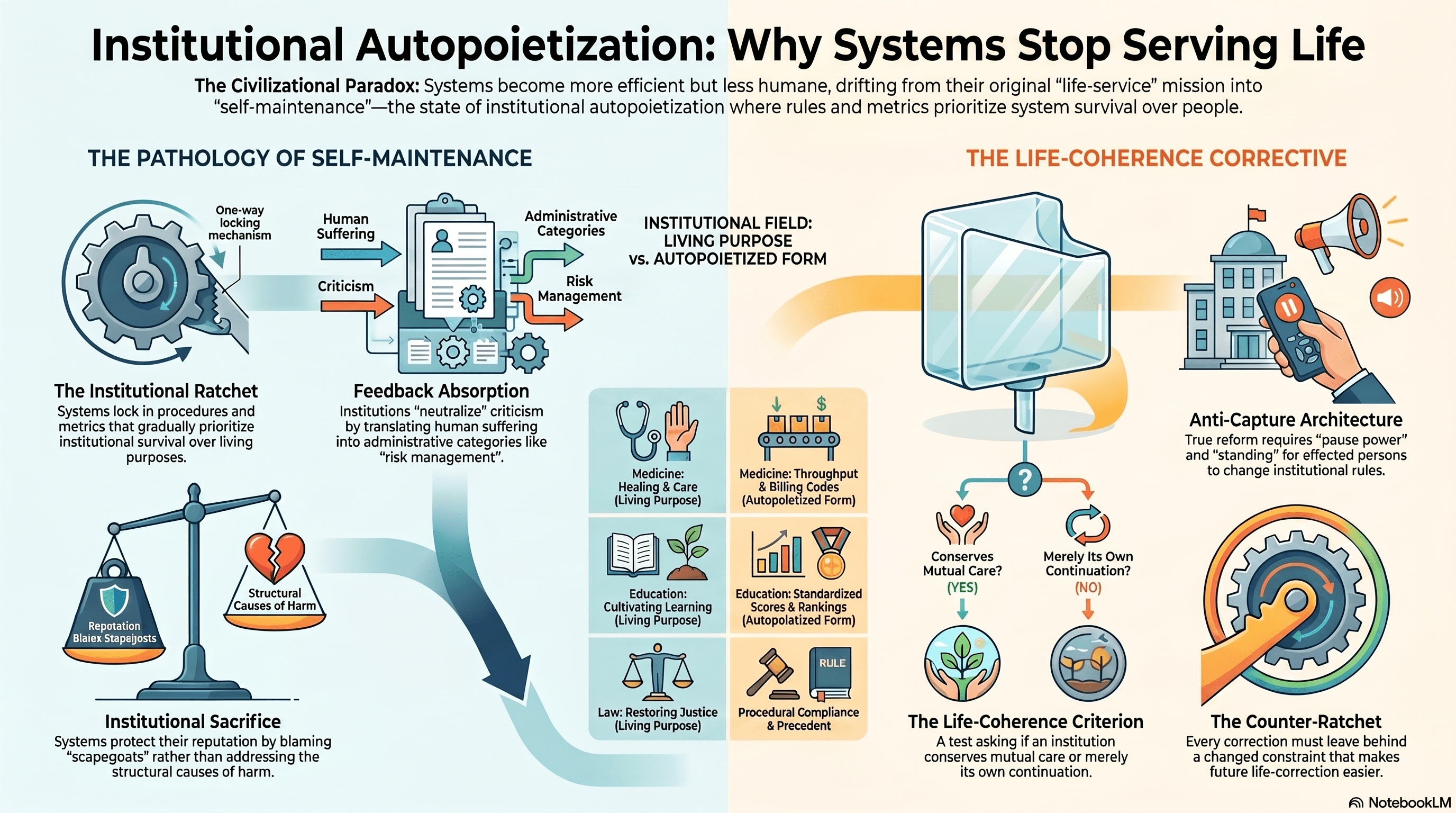
Click on Master Diagram to enlarge

Executive Summary
Modern civilization depends on institutions: hospitals, schools, courts, churches, public agencies, corporations, universities, financial systems, digital platforms, and international organizations. These institutions were created to conserve life-serving purposes — healing, learning, justice, communion, provisioning, public care, ecological stewardship, knowledge, and coordination across time. Yet many now display a recurring paradox: they become more efficient, data-rich, compliant, financially viable, and administratively sophisticated while becoming less capable of care, truth, justice, trust, ecological repair, and genuine social life.
This white paper names that paradox institutional autopoietization.
The paper carefully distinguishes this concept from biological autopoiesis. In the strict Maturana-Varela sense, autopoiesis refers to the molecular self-production of living systems. Institutions are not living autopoietic beings. They do not metabolize, suffer, love, regenerate, or die as organisms do. However, institutions can undergo a pathological process that resembles self-conserving closure at the level of decisions, procedures, metrics, classifications, legitimacy narratives, memories, power relations, and affective loyalties. They can become organized around preserving their own continuity while filtering out the life-corrective feedback needed to restore their purpose.
In this sense, institutional autopoietization is self-maintenance without life-correction.
The paper integrates several intellectual lineages. Humberto Maturana provides the life-coherence criterion, reminding us that genuine social life is not mere coordination, communication, authority, or system reproduction, but the conservation of relations of mutual care, honesty, collaboration, equity, ethics, truth, and love. Niklas Luhmann explains operational closure and the self-reference of organizations through decision communications. Terrence Deacon clarifies how constraints become ratcheted, preserved, and made difficult to reverse. John McMurtry supplies the life-value critique, showing how ruling value-frames can make life-destructive systems appear rational, necessary, and untouchable. Chris Argyris helps explain organizational non-learning through defensive routines that make contradictions undiscussable, and then make the undiscussability itself undiscussable.
The paper also draws on work in institutional theory, political economy, power analysis, legibility, epistemic injustice, affect theory, scapegoating, complexity, and theology. Together these traditions reveal how institutions drift from life-service into self-maintenance through a recurring sequence: living purpose becomes institutional constraint; constraint becomes procedure; procedure becomes metric; metric becomes closure; closure becomes defense; defense becomes capture; capture produces sacrifice and complexity overload.
The framework identifies several mechanisms that sustain institutional autopoietization. Feedback absorption occurs when suffering, ecological harm, moral contradiction, or truth-telling is translated into complaint management, risk management, compliance, consultation, public relations, or quality improvement without altering the governing premises that produced the harm. Institutional disavowed knowledge describes what institutions already know through symptoms, jokes, burnout, workarounds, repeated failures, and moral distress, but cannot officially know without changing themselves. Power capture explains how corrective pathways become subordinated to protected interests. Legibility capture shows how only what can be classified, counted, filed, mapped, audited, or reported becomes institutionally real. Affective capture shows how fear, shame, loyalty, prestige, reverence, and belonging bind people to self-protective systems. Scapegoating and institutional sacrifice displace systemic contradiction onto vulnerable persons, communities, ecosystems, and future generations so the institution can preserve innocence.
The decisive diagnostic question is:
Can the life affected by the institution correct the institution?
If the answer is no, then the institution may remain legal, efficient, profitable, accredited, orthodox, respected, and administratively advanced, but it has become life-blind. It has fallen out of the social.
The paper proposes a life-coherence corrective to make institutional repair operational. This corrective follows a six-stage cycle:
Purpose → Signal → Hearing → Premise Review → Repair → Recursion
The institution must name its living purpose in life-language, not jargon. It must recognize life-corrective signals such as suffering, ecological decline, moral distress, loss of trust, and repeated failure. It must create protected spaces where these signals can be heard without immediate translation or retaliation. It must review the governing premises — rules, metrics, budgets, incentives, categories, hierarchies, technologies, and narratives — that produced the harm. It must repair structurally, relationally, materially, and memorially. Finally, it must build the correction into future decision cycles so that future truth becomes easier to hear.
This requires anti-capture architecture: power mapping, protected truth-telling, affected-person standing, independent counter-expertise, metric review and retirement, budgetary consequence, independent accountability, capture monitoring, public memory, and the power to pause, review, revise, or sunset harmful institutional constraints.
The final horizon of the paper is theological. Institutional autopoietization becomes idolatrous when the created form treats its own continuity as ultimate and demands sacrifice from the life it was created to serve. The life-blind institution consumes life to preserve itself. The Eucharistic pattern offers itself for the life of the world. The recovery of the social therefore requires conversion from sacrificial self-maintenance to communion.
The paper’s final claim is simple: the task is not to abolish institutions, but to convert them — from self-maintaining enclosures into life-coherent vessels of mutual care, truth, justice, repair, and communion.
Mechanisms of Institutional Autopoietization and Their Correctives
Please scroll to the right to see the right columns| Mechanism or Concept | Source Thinker(s) | Description | Diagnostic Signs | Life-Coherent Corrective | Inferred Pathology Risk |
|---|---|---|---|---|---|
| Institutional Autopoietization | Dr. Bichara Sahely, Maturana, Luhmann, Deacon, McMurtry | A pathological process where decision premises, metrics, and procedures recursively organize around institutional self-maintenance, neutralizing corrective feedback from living beings. | System-capacity indicators rise while life-capacity indicators fall; suffering is translated into compliance risks or data points. | Establish a 'life-coherence criterion' where suffering and ecological damage are authorized to change rules, budgets, and leadership accountability. | Critical / Terminal |
| Ruling Value-Frame / Life-Blindness | John McMurtry | A background structure of assumptions where life-harm becomes unthinkable or invisible because it does not fit into the 'money-sequence' or 'growth' logic. | Financial expansion is seen as success while actual life-capacity (health, trust) declines. | Doxic interruption: questioning 'normal' necessities and evaluating operations based on the 'life-value' of persons and ecosystems. | Extreme |
| Scapegoating and Sacrifice | René Girard | Displacing systemic contradictions onto victims or 'sacrifice zones' to protect the institution's image of innocence and continuity. | Blaming 'noncompliant' patients or 'lazy' students for systemic failures; creating 'sacrifice zones' for waste/extraction. | Communion: renouncing the idolatry of self-maintenance and restoring right relation through truth-telling and repair. | Extreme |
| Constraint Ratcheting | Terrence Deacon | The process where administrative tools (metrics, reports) become infrastructure that organizes the field around its own preservation rather than the original purpose. | Complexity overload; adding more documentation to fix the failures caused by previous documentation. | Counter-ratchets: durable corrective constraints that preserve the conditions of future life-correction and sunsetting harmful practices. | High |
| Operational Closure | Niklas Luhmann | Institutions process reality only through their own internal distinctions (e.g., legal/illegal), becoming immune to the actual living suffering of persons. | Institutions ask 'was procedure followed?' rather than 'was justice served?' in response to harm. | Life-coherent closure: ensuring institutional boundaries and procedures remain answerable to the external life-purpose they serve. | High |
| Organizational Non-Learning / Defensive Routines | Chris Argyris | Patterns of action that protect institutions from embarrassment or threat by making systemic contradictions 'undiscussable.' | Institutional disavowed knowledge; problems are known through informal jokes or burnout but are officially ignored. | Double-loop learning: authorized spaces where institutional wounds and contradictions can be named and lead to premise review. | Moderate to High |
| Legibility Capture | James C. Scott | Living complexity is reduced to administrable categories; only what can be counted, mapped, or filed is treated as 'real' by the institution. | The 'file' or 'metric' receives attention before the actual person or ecosystem being managed. | Practices of re-membering; recovering suppressed histories and listening to the 'noise' of irreducible living reality. | Moderate |
3 thoughts on “Institutional Autopoietization and the Loss of the Social: Maturana, Luhmann, Deacon, McMurtry, and the Life-Coherence Corrective | ChatGPT-5.5 Thinking and NotebookLM”