

Download Full Document (PDF)
Audiobook on ElevenReader (Listen)
NotebookLM (Notebook)
Life Coherent Finance (PDF) (PPT)
The Life-Coherent Finance Blueprint (PDF) (PPT)
Life-Coherent Financing (PDF) (PPT)
Deep Dive | Why debt consumes the living world
Debate | When financial abstractions outpace the living world
Critique | Making Life-Coherent Financing Practical
Video Explainer | Life-Coherent Financing
Cinematic | The Pathology of Financial Drift
Click on infographic to enlarge

Click on the Master Diagram to enlarge

Executive Summary
Finance is not merely an economic subsystem. It is a civilizational grammar of future-making. Through money, credit, debt, interest, investment, taxation, banking, and digital payment systems, societies decide what counts, what is funded, what is deferred, what is sacrificed, what is forgiven, and what kinds of life may continue (Graeber, 2011; Ingham, 2004; Pistor, 2019; Zelizer, 1994).
The dominant financial system is commonly described in technical terms: interest rates, credit markets, fiscal deficits, bank regulation, capital flows, asset prices, liquidity, inflation, sovereign debt, exchange rates, derivatives, pensions, cryptocurrencies, and central bank digital currencies. These are necessary categories, but they do not by themselves answer the deeper question: what is finance for?
This white paper argues that finance must be judged by its relationship to life-capacity. A financial system is life-coherent when it helps persons, households, communities, institutions, societies, ecosystems, and future generations preserve, restore, and extend their capacities to live well. It is life-incoherent when it converts living systems into collateral for compounding claims.
The paper develops this argument through three primary philosophical foundations.
First, from Humberto Maturana, finance is understood as a structure of social coordination and world-bringing (Maturana & Varela, 1980, 1992). Money does not simply measure a pre-existing reality; it helps bring forth a world of distinctions, incentives, expectations, and obligations. Financial systems shape the domains of action that societies conserve. They influence whether people see housing as shelter or asset class, care as life-reproduction or unpaid externality, public spending as democratic provisioning or fiscal burden, nature as life-ground or monetizable stock, and future generations as inheritors or debt-bearing abstractions.
Second, from John McMurtry, finance is evaluated by the life-value test (McMurtry, 1998, 1999, 2013). Money-sequences are legitimate only insofar as they serve life-sequences. When the growth of money claims becomes the ruling value, life itself is subordinated to abstract accumulation. This inversion appears wherever debt service outranks human need, shareholder yield outranks ecological continuity, austerity outranks public health, tax avoidance outranks civil reciprocity, and speculation outranks provisioning.
Third, from Johan Galtung, finance is examined as a possible structure of violence (Galtung, 1969, 1990, 1996). Financial harm often occurs without direct physical aggression. Debt peonage, forced austerity, predatory lending, avoidable poverty, climate underinvestment, exclusion from payment systems, tax-base erosion, and speculative housing inflation can damage bodies, shorten lives, destabilize societies, and degrade ecosystems while appearing as ordinary market outcomes. The violence is structural because it is built into rules, incentives, institutions, and enforceable claims.
The paper then widens the frame. David Graeber challenges the myth that money simply evolved from barter, showing debt and obligation as deep social relations (Graeber, 2011). Michael Hudson reveals the ancient recognition that compound debt can grow beyond social life-capacity, requiring periodic cancellation or reset (Hudson, 2018). Bernard Lietaer points toward monetary ecosystems and complementary currencies. Steve Keen and Hyman Minsky reveal finance as endogenously unstable when credit expansion and leverage reduce systemic margin. Richard Werner shows that the central question is not merely the quantity of money, but the allocation of credit (Werner, 1997, 2003). Modern Monetary Theory clarifies that sovereign currency issuers are not financially constrained like households; their real constraints are productive capacity, inflation, ecological limits, distribution, and political legitimacy (Kelton, 2020; Mitchell et al., 2019; Wray, 2015).
Additional literatures are needed for full-spectrum diagnosis. Karl Polanyi shows why land, labor, and money are fictitious commodities whose subjection to market rule threatens the life-ground (Polanyi, 2001). Wynne Godley’s stock-flow consistent approach clarifies that one sector’s financial asset is another’s liability, making finance inherently relational. Katharina Pistor shows how law codes capital into enforceable, durable, privileged claim-power (Pistor, 2019). Perry Mehrling and Zoltan Pozsar expose the hidden plumbing of repo, collateral, shadow banking, liquidity chains, and central-bank backstops (Mehrling, 2011, 2013; Pozsar, 2014, 2015). Nancy Folbre and feminist care economics reveal the financial invisibility of unpaid and underpaid care (Elson, 2017; Folbre, 2001, 2008, 2021; Waring, 1988). Herman Daly, Nicholas Georgescu-Roegen, and ecological economics show that monetary expansion cannot override biophysical limits (Daly, 1996, 2005; Daly & Farley, 2011; Georgescu-Roegen, 1971). Elinor Ostrom provides a theory of commons governance (Ostrom, 1990). Mariana Mazzucato reframes public finance as mission-oriented value creation (Mazzucato, 2013, 2018, 2021). Tax justice, offshore finance, sovereign debt, insurance, climate finance, digital money, artificial intelligence, and programmable monetary systems all become essential parts of the same field.
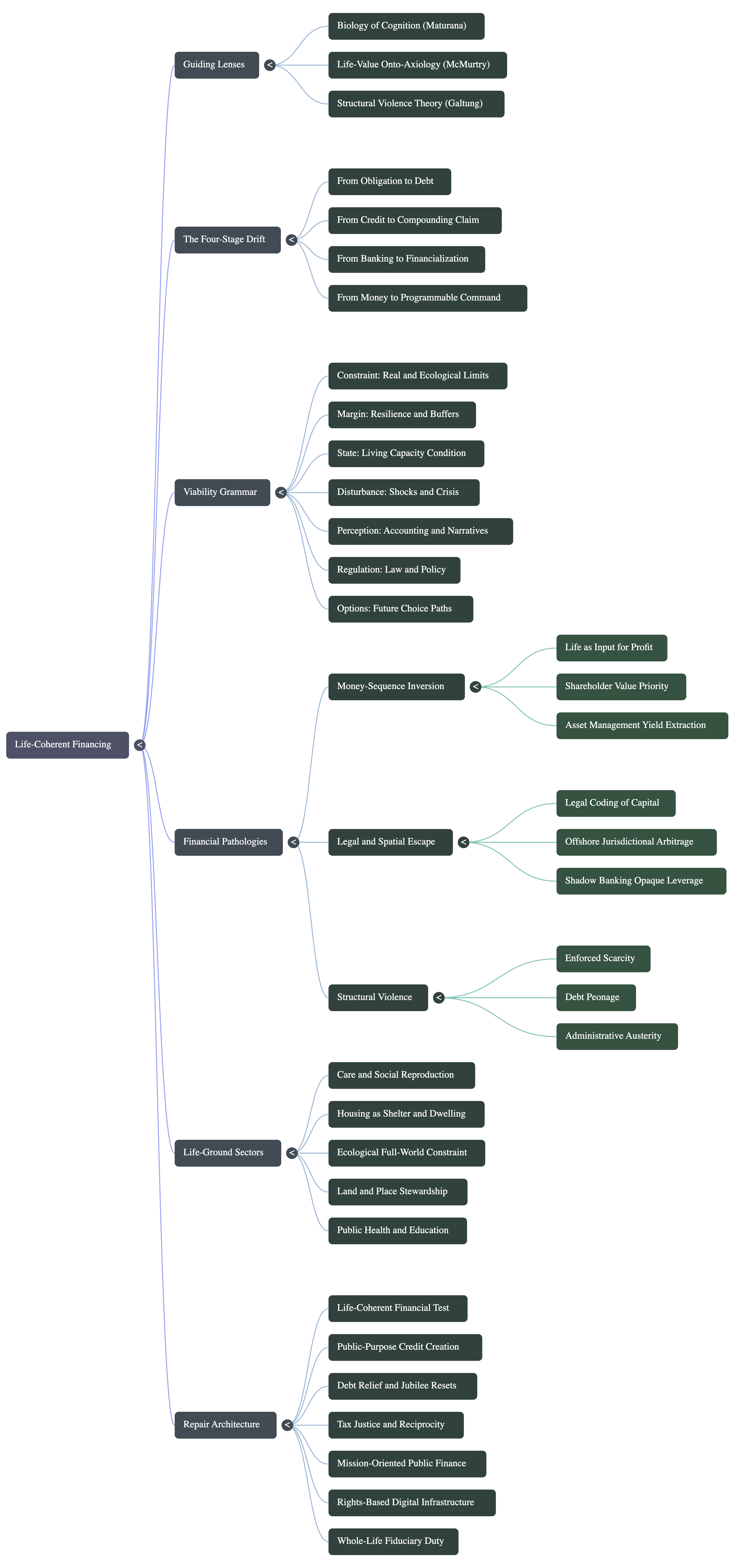
The paper’s organizing pattern is a four-stage drift:
- From obligation to debt
Social memory, reciprocity, and trust become enforceable obligation. - From credit to compounding claim
Credit that can enable future life-capacity becomes interest-bearing debt that may grow beyond the debtor’s real capacity to pay. - From banking to financialization
Credit creation and investment shift from provisioning toward asset inflation, leverage, rent extraction, and speculative claims. - From money to programmable command
Digital currency, algorithmic finance, and programmable payment systems create new possibilities for inclusion and resilience, but also for surveillance, exclusion, automated extraction, and behavioral control.
Against this drift, the paper proposes a counter-drift: from claim-power back to life-credit.
Life-coherent financing would not eliminate money, credit, banking, or digital currency. It would re-embed them in life-ground accountability. It would ask, at every point: who creates money, who receives credit, who pays interest, who bears risk, who is rescued, who is abandoned, who is visible, who is excluded, who decides, and what forms of life are conserved?
The proposed principle is:
No financial claim is legitimate beyond the life-capacity of the persons, communities, ecosystems, and future generations required to honor it.
From this principle follow several repair pathways:
- Credit should be directed toward productive, regenerative, and life-serving purposes rather than speculative asset inflation.
- Debt relief should be available where obligations exceed life-capacity and threaten social viability.
- Public banking and mission-oriented finance should support health, housing, care, education, ecological repair, food security, energy transition, and community resilience.
- Tax systems should reconnect private gains to the civil commons that make those gains possible.
- Offshore secrecy and jurisdictional arbitrage should be treated as escapes from reciprocity.
- Pension funds, mutual funds, and asset managers should be evaluated by their effects on life-capacity, not only by yield.
- Climate finance should avoid converting ecological repair into another field of rent extraction.
- Digital money should be governed as democratic public infrastructure, not as a mechanism of programmable domination.
- Artificial intelligence in finance should be judged by what it makes visible, what it excludes, and whether its classifications protect or harm life.
- Complementary currencies, commons finance, and care-centered investment should be explored as ways to restore plurality, resilience, and relational accountability.
The aim of life-coherent financing is not the destruction of finance, but its healing. Finance is necessary because human beings live through time, uncertainty, interdependence, trust, and collective provisioning. But finance must be returned to its proper place. It is not the master system. It is not the measure of all value. It is not entitled to grow without limit. It is a symbolic and institutional organ of the living whole.
The final claim of this paper is therefore simple:
Finance must be judged not by the quantity of money it multiplies, but by the quality of life-capacity it preserves, restores, and enables.
A Maturana–McMurtry–Galtung Framework for Life-Coherent Financing
Please scroll to the right to see the right columns| Financial Category | Life-Coherent Definition | Life-Incoherent (Extractive) Form | Primary Philosophical Lens | Viability Primitives Affected | Repair Pathways |
|---|---|---|---|---|---|
| Debt | An obligation that enables future capacities (learning, shelter, planting) under terms aligned with capacity and shared risk. | Future capture; interest-bearing claims that grow exponentially regardless of crops failing, illness, or ecological damage. | Galtung (structural violence) / McMurtry (life-value) | Constraint, Margin, Disturbance, Options | Debt relief, restructuring, and Jubilee resets where claims exceed life-capacity; climate-resilient debt clauses. |
| Credit | Social recognition of future possibility; trust extended to expand the capacity of life to flourish through provisioning. | Compounding claims and speculative asset inflation; credit used to bid up land prices and trap households in dependency. | Maturana (structural coupling/world-bringing) | Perception, Options, State | Credit guidance toward productive and regenerative purposes; public development banking; land-value taxation. |
| Banking | A publicly licensed system for authorizing and coordinating claims upon the future in service of public purpose. | Financialization; shifting from provisioning to asset stripping, fee extraction, and speculative leverage in the shadows. | Werner (credit allocation theory) / Minsky (instability) | Regulation, Margin, State, Disturbance | Public banking; functional regulation of shadow banking; restricting speculative lending; democratic oversight of the monetary franchise. |
| Public Finance / Sovereign Currency | Democratic provisioning and mobilization of real resources for the civil commons and life-infrastructure. | Fiscal scarcity myth; austerity that protects financial claims by degrading public health, education, and ecological safety. | McMurtry (life-value) / Modern Monetary Theory (MMT) | Constraint, Perception, State, Options | Real-resource budgeting; job/care guarantees; tax justice as reciprocity; reclaiming monetary sovereignty from creditor discipline. |
| Digital Money / Programmable Power | Rights-based digital public infrastructure that expands access, resilience, and democratic participation. | Programmable command; automated exclusion, behavioral scoring, and surveillance-based financial control. | Galtung (programmable violence) / Maturana (coordination) | Perception, Regulation, Options, Disturbance | Privacy-by-design; offline resilience; legal limits on programmability; democratic digital monetary commons. |
| Climate / Ecological Finance | A circulatory system for repair and restoration of the life-ground, bounded by biophysical thresholds. | Green financialization; converting ecological repair into rentier frontiers and using debt-financed adaptation to trap vulnerable states. | Daly (ecological economics) / McMurtry (life-ground) | Constraint, Margin, State, Disturbance | Ecological budgeting; grants-based loss and damage; regenerative credit; ending finance for life-destructive extraction. |
Click on Mind Map to Enlarge
One thought on “Life-Coherent Financing: Money, Debt, Credit, and the Drift from Life-Service to Life-Extraction | ChatGPT-5.5 Thinking and NotebookLM”