

[Download Full Document (PDF)]
Deep Dive Audio Overview
Video Explainer
Infographic (Please click on image to enlarge)
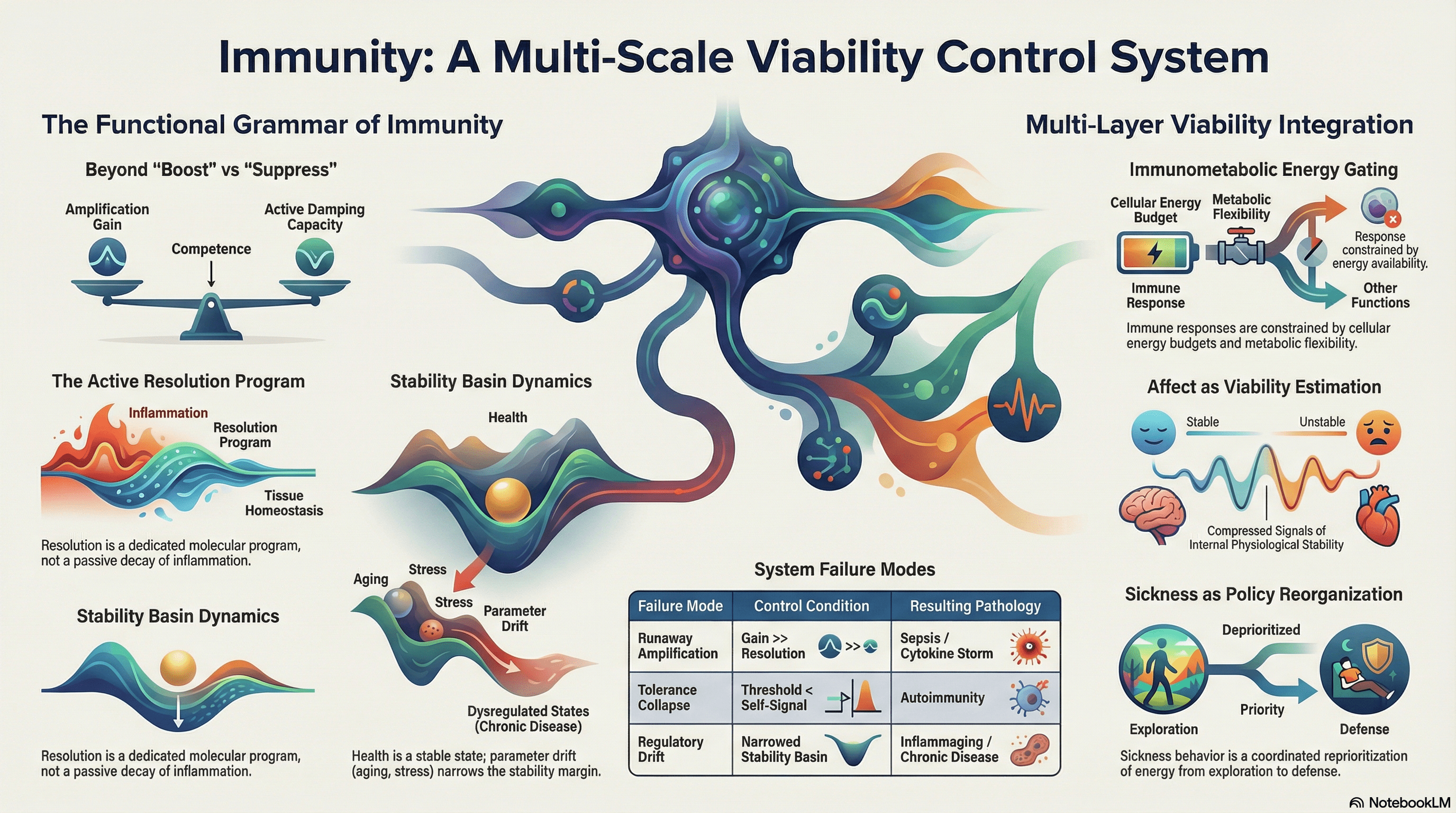
Executive Summary
Modern immunology has successfully characterized the molecular mechanisms of pathogen recognition, clonal expansion, and effector function. Yet increasing empirical complexity — including microbiome tolerance, tissue-specific immune specialization, chronic inflammatory drift, immunometabolic regulation, and structured neuroimmune signaling — indicates that immunity cannot be fully understood as a linear defense apparatus.
This paper proposes that the immune system functions as a distributed viability-regulating control system embedded within organismal energy budgets, circadian rhythms, tissue ecologies, and behavioral integration. Across phylogeny, immune architectures converge upon a consistent functional grammar: boundary protection, perturbation detection, nonlinear amplification, active resolution, memory, metabolic integration, and temporal modulation. These modules reflect a constrained evolutionary solution to maintaining organized biological systems under adaptive threat.
We further argue that immune–brain integration is structurally embedded within this architecture. Inflammatory signals are continuously incorporated into interoceptive neural networks, influencing motivational state and behavioral policy. Sickness behavior and inflammation-associated affective changes are therefore interpreted as coordinated organism-level adjustments rather than incidental byproducts. Affective states may function as compressed representations of organismal viability under constraint, shaped in part by immune signaling.
Chronic diseases — including autoimmune disorders, cardiometabolic inflammation, cancer immune escape, and subsets of mood syndromes — are reframed as stability failures within this coupled immune–neural system. Rather than emphasizing immune activation alone, the framework prioritizes resolution efficiency, gain calibration, metabolic flexibility, circadian amplitude, and repertoire diversity as determinants of long-term stability.
This reconceptualization invites a research agenda that integrates systems modeling, neuroimmunology, and resolution biology while remaining grounded in empirical immunological methods. Immunity emerges not solely as a guardian against pathogens, but as a central regulator of organismal stability across time.
Immune System Functional Modules and Evolutionary Recurrence
Please scroll right to see right columns| Functional Module | Prokaryotes Implementation | Invertebrates Implementation | Jawless Vertebrates Implementation | Jawed Vertebrates Implementation | Biological Function Description | Control System Role (Inferred) |
|---|---|---|---|---|---|---|
| Boundary | Membrane integrity | Epithelial barriers | Tissue barriers | Specialized epithelial & vascular barriers | Initial physical separation and protection of the organism's internal environment from external environment. | System boundary definition and isolation of internal state from external noise. |
| Detection | Restriction systems, CRISPR | PRRs | VLRs + PRRs | PRRs + TCR/BCR | Identification of exogenous disruption, pathogens, or internal damage-associated signals. | Sensor input and signal transduction identifying deviations from homeostasis. |
| Amplification | Rapid enzymatic degradation | Cytokine-like cascades | Cellular expansion | Cytokine networks + clonal expansion | Nonlinear scaling of detection events into robust systemic or cellular responses. | High-gain signal processing to ensure response magnitude matches threat level. |
| Effector | Nuclease-mediated cleavage | Phagocytosis, peptides | Cytotoxic cells | Cytotoxic + humoral | Deployment of molecular or cellular mechanisms to neutralize perturbations. | Actuator deployment to perform corrective work on the system state. |
| Resolution | Limited | Regulated cell death | Regulatory modulation | Specialized pro-resolution mediators | Active termination of inflammation and restoration of tissue integrity and homeostasis. | Negative feedback and damping mechanisms to prevent runaway instability. |
| Memory | CRISPR spacers | Immune priming | VLR memory | Adaptive memory | Storage of prior exposure data to facilitate faster/stronger responses to recurring threats. | Update of internal model to improve predictive control and future viability. |
| Energy Integration | Metabolic gating | Systemic metabolic shifts | Metabolic reprogramming | Immunometabolism specialization | Coupling of immune activity with cellular and organismal energy budgets. | Resource-constrained optimization of regulatory effort. |
| Temporal Regulation | Stress-response timing | Developmental modulation | Adaptive memory timing | Circadian + developmental calibration | Alignment of immune activity with predictable environmental cycles and organismal life stages. | Scheduling of high-cost activity to optimize efficiency and reduce baseline drift. |


